


Did Video Kill the Radio Star, or Did AI Kill the Artist?
EDITORIAL
By Indi Tejeda
2/3/26
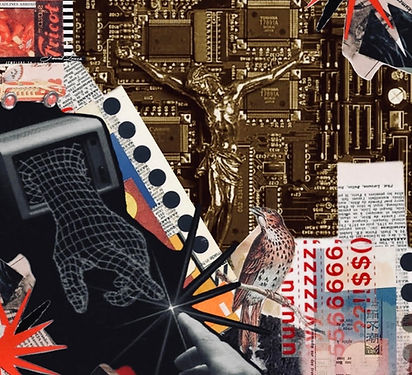
Collage by Indi Tejeda
In 1981, English new wave band The Buggles famously declared that “video killed the radio star.” However, it wasn’t a death: it was a metamorphosis. Success shifted from the ear to the eye and artists simply evolved, trading their microphones for music videos.
Today, we face a shift that feels less like an evolution and more like an audit. As artificial intelligence begins to churn out "art" at scale, we aren’t just asking if the medium will change. We are asking if the human at the center of the medium is still necessary.
The Ghost in the Canvas
The fear of technology is nothing new. When photography first emerged, painters were terrified they’d be replaced by a box and a lens. Instead, painting was liberated. Relieved of the duty to document reality, painters explored emotion and abstraction, giving birth to Impressionism, a 19th-century art movement. But AI is a different beast. It doesn't capture reality; it borrows from the collective history of human effort. Philosopher Walter Benjamin famously argued that an original work of art possesses an "aura," a unique, one-of-a-kind energy rooted in its specific time and place. He believed that mass-producing copies caused this "magic" to decay. If Benjamin thought a printing press could dilute an artist's soul, one can only imagine what he would think of an algorithm that can generate a million "original" styles in a second.
Robotic Takeover
This decay is no longer a theory, it is a pervasive cultural presence. AI is now designing for Vogue, saturating Spotify, and occupying art galleries, sharing the stage with living artists without needing a physical pulse. This phenomenon forces a critical question: if a machine can produce "art," is the medium still inherently human? While AI can mirror complex techniques, art is traditionally defined by the lived experience of its creator. At a distance, digital brushstrokes and synthesized lyrics appear convincing, leading some to compare AI to tools like Photoshop. However, the difference is unmistakable. AI operates through pattern recognition and does not attach emotion or significance to its output. Humans create from memory and heart, yet machines generate from data. In any other context, imitation without original intent is labeled as forgery or plagiarism, a term that underscores our societal preference for authenticity over replication. This tension extends beyond aesthetics into the realms of ethics and identity. The case of FN Meka, the AI “rapper” briefly signed by Capitol Music Group, serves as a primary example. The project triggered a backlash regarding "digital blackface," as the algorithm adopted a persona of color and utilized racial slurs without possessing a human identity. The controversy highlighted a glaring double standard: society does not excuse human artists for fabricating identities, so why grant a pass to a machine?
From Creators to Curators: The Legal Frontier
When we grant this pass to a machine, the consequences are more than just ethical, it’s structural. This economic shift is where the "death" feels most literal. The video era created jobs, such as directors, stylists, and choreographers. AI, by contrast, is a compressor. It doesn't necessarily delete the artist, but it shifts their role. It's moving artists from being creators to becoming curators. Entry-level roles are shrinking as tasks become automatable. Output expectations are skyrocketing. In an economy driven by speed, scale has become the ultimate weapon. The threat isn’t that AI will produce better art than you. It’s that it will produce faster, cheaper, and endless content, drowning out the human signal in a flood of synthetic noise. Unlike previous shifts, artists today are fighting back in the courtroom. We are currently in the middle of a massive legal "land grab" over training data. Can a machine use your life’s work to learn how to replace you? For now, the law sides with humanity. In the United States, copyright still requires "human authorship." A prompt alone doesn't make you an artist in the eyes of the law. This legal boundary reinforces a powerful cultural truth: creativity is still, for the moment, a protected human territory.
The New Luxury: Authenticity
History tells us that technology rarely kills art. It just changes what we value. Photography didn’t kill painting; it made the painter's unique perspective more valuable. Streaming didn’t kill music; it turned the "live experience" into a premium product. We are likely headed toward a tiered creative world. Mass-market content, the background music in elevators, and the stock photos in brochures will be automated. It will be fast, cheap, and disposable. Meanwhile, human-made art will become a luxury. We see this pattern in other parts of our lives. Things that used to be basic necessities often become luxuries once they become inaccessible. Homemaking became a luxury once a single income could no longer support a household. Gardening and fresh produce became premium experiences in the face of a surplus of processed, fast food. As efficiency becomes the default, the "slow" and "manual" versions of life gain a new kind of prestige. In the same way, we will most likely value human-made art more than ever after this shift, primarily because it represents effort, vulnerability, and struggle. In a world of digital perfection, the "flaw" becomes the feature, and in the world of music, the grit and edge take center stage.
The Final Question
Ultimately, the question isn’t whether AI will kill the artist. The question is how we, as an audience, will choose to spend our attention. If technology can provide instant access to every artistic endeavor, will audiences continue to value the work of those who dedicate significant time and effort to expressing human vulnerability? The answer to that question won’t just shape the future of the art market, but will define the future of our culture.
References
Benjamin, W. (2010). The work of art in the age of mechanical reproduction (J. A. Underwood, Trans.). Penguin Books. (Original work published 1935).
The Buggles. (1979). Video Killed the Radio Star [Song]. On The Age of Plastic. Island Records.
Coscarelli, J. (2022, August 23). Capitol Records drops ‘AI rapper’ FN Meka after backlash. The New York Times. https://www.nytimes.com/2022/08/23/arts/music/fn-meka-dropped-capitol-records.html
House, L., & House, N. (2015, May 5). Impressionism: The influence of photography. Kiama Art Gallery. https://kiamaartgallery.wordpress.com/2015/05/05/impressionism-the-influence-of-photography/
U.S. Copyright Office. (2023). Copyright registration guidance: Works containing material generated by artificial intelligence (Federal Register Vol. 88, No. 51). Library of Congress. https://www.copyright.gov/ai/ai_policy_guidance.pdf
Fuchs, C., Schreier, M., & van Osselaer, S. M. (2015). The handmade effect: What’s love got to do with it? Journal of Marketing, 79(2), 98-110. https://doi.org/10.1509/jm.14.0018