


No Model are Not Your Model Minorities
INTERVIEWS
By Olivia Lee
4/27/26
In a scene where Asian presence is limited, No Model doesn’t want to fit into a model minority role, but rather expand what representation in punk music can look like.

Olivia with No Model posing for prom (Photo by Mas Yamada).
7 bands. That’s how many were playing at the Seattle stop of the Real Asian Hate tour – a split tour between East Coast hardcore bands Ferment, No Model, and Dog Breath, with support from local hardcore groups – which fortuitously ended up being my first ever hardcore show.
With so many bands on the lineup, I wasn’t sure which ones I’d end up focusing on. But after reading about the members’ of No Model and their backgrounds as Korean adoptees, I knew I had to interview them, immediately relating to their experiences of Asian displacement.
Lead vocalist Sehun Ji met guitarist Chang-hwan Kim at a Have Heart reunion show in 2019, where they both bonded over being Korean adoptees. Their newfound friendship inspired them to start a band together, leading Sehun to bring in bassist Pocholo Itona and guitarist Nic Palermo into the fold – musicians he’d known from his previous projects. After recruiting drummer Noel Herbolario, Sehun gathered everyone in a group chat during the pandemic, where (as he puts it) “bullied everyone into being in a band” with him. Despite being spread out over four states, the band remains a favorite in the East Coast hardcore scene, even taking their apoplectic sound overseas with a 2025 tour in Korea and Japan alongside fellow Asian hardcore band Sour.
Wedged into the corner of the Black Lodge’s front room, the quintet and I discussed Asian representation in hardcore, Sehun’s record label (aptly named Kill Yellow Fever), and what’s next for the band (spoiler alert: they’re breaking up this year).
How would you describe your sound and how does it connect to who you are as a band?
Chang-hwan: We've kind of gone a lot of places with it, but I'm personally very influenced by punk leaning, hardcore from the Boston area in the early to mid-2000s. Bands like Out Cold, Suicide File, R&R to an extent. Just rock and roll leaning, hardcore, street music.
Sehun: And also Nine Shocks Terror and Japanese hardcore bands, and just sounding like I'm about to explode on the mic, and sounding like I'm dying and wanting to kill people and myself.
I've read that you guys grew up as Korean adoptees in the USA. How that experience shaped you guys as musicians, and how did that eventually connect you to the hardcore community?
Sehun: It kind of influenced just how angry I was at the world, even when I was younger and not knowing why I was angry. But now knowing why my anger is valid, and using that anger to help unite other adoptees and other Asians in our community, and showing other adoptees that hardcore was my space to really find myself. It's a big reason why I'm still here today, as corny as that sounds.
Chang-hwan: I would definitely echo that. I think a lot of Asian people can identify with this, but adoptees in particular are kind of plopped into areas that they don't belong in, or they were never meant to be in. I myself in particular grew up in a very small vacation, summer community type of space. I was like the only Asian person in my grade for sure. In my high school I think I was one of three. And kind of to Sehun's point, the punk and hardcore scene gave me a spot to be.
I think a lot of adoptees are looking for a spot to feel at home, and we're very adaptable in that sense, because we've never experienced what that home is actually like. So the punk and hardcore scene was just very natural. I think I've been going to shows since I was 12 and I'm 36 now. So it's been a long, long time of just finding a place and kind of running with it.
How has your heritage influenced your music, if at all?
Pocholo: This might not be the most eloquent way of saying this, but I mean I was really into punk and hardcore as a kid. I feel like I connected with it as a way of just finding who I was.
So it didn't really have that much connection to being Filipino for me at first, but recently I've been learning a lot more about Filipino resistance against a lot of their oppressors throughout history. I feel like the more I understand how punk and hardcore leave space for a lot of political rage in places, I really see how that has always been a part of Filipino history. I didn't think that that would be the case, but I thought it's cool that as I learn more about Filipino resistance against the Spanish and the Japanese, I'm just like, ‘Wait, they were punk as fuck for centuries.’ My heritage hasn't really influenced it, but they're kind of convening together to guide me now that I'm discovering how much overlap there is.
Chang-hwan: I think one thing that's kind of bothering me right now is people saying that, ‘Oh, why aren't there more punk and hardcore bands speaking out because there's so much bad going on in the world?’ But to me I think that response is reactionary, and they were never about it to begin with. And it just seems kind of performative and weird. I don't want to hear whatever band, whatever thing they've been on not speaking about it, and just going about their way suddenly start talking about it now. That feels fake to me. So this band came out of the gate speaking, as Pocholo said, about the resistance efforts that are intrinsic to who we are as people. Koreans pushing back against military occupation of the U.S. and Korea. The adoptee aspect of adoption being an extension of U.S. imperialism. Buying children is fucking awful. So I just think something we kind of took on from the beginning is weaponized Asian-American diaspora, and I think that's what we kind of live by, is that we're not trying to fit in with this model minority group. We're not suddenly reacting to something that's happening. This is just kind of tapping into our roots and intrinsically who we are.
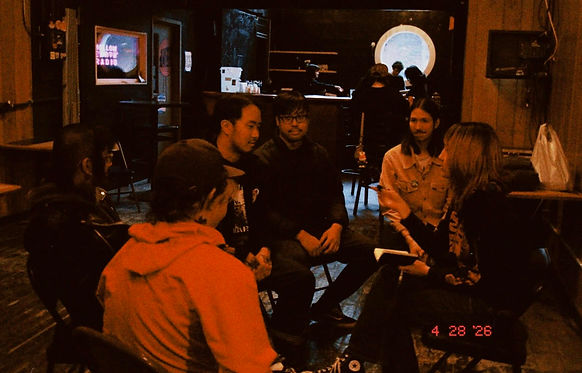
Olivia interviewing No Model at The Black Lodge (Photo by Mas Yamada).
Sehun, you founded Kill Yellow Fever, right? Tell me more about that. What were the origins and the motivations for founding it?
Sehun: So it started in 2022. I put out Pocholo's other band, Doubt, their demo, and they had a great response and the release show was great, and now they're on Get Better Records and doing really cool things. It's grown with putting out Doubt's demo and then putting out No Model’s stuff and then now PsyOp from D.C., Brainwash from Philly, The Tarrys from New York are on there, and then also No Values. And No Model did a split with Pilau from D.C. So yeah, just trying to put out Asian-fronted bands. I want to eventually do distro for different bands in Asia and different bands in Korea and try to get their music out here because there's just so much cool shit happening over there. I feel like there's only a border because people aren't willing to try to find cool shit going on. We got to tour Korea and Japan and the outpouring of love they have for their scenes is amazing and seeing how much work they put into what they do is incredible and I just want them to get more recognition for it.
Honestly, the main reason why I started the label was because I wanted to put out my own band’s stuff. I was probably expecting to work with my friends on releasing their music, but I was like, ‘Hey I don't want to be on another label because I don't trust white people with my music, and I don't want them profiting off my hatred and anger.’ So this is my way to still be super DIY with shit and do what I want.
You guys obviously take pride in your identity as an Asian-fronted band. Why is it important for you guys to cultivate community within the Asian hardcore scene?
Sehun: I think it's important because there's too many fake spaces or not actual safe spaces for Asians right now. I hate the idea of people having to become influencers to try to find their space in the world. There's just so much fake performative crap right now I know it's not (realistically) the purest thing in the world but to me, hardcore’s the purest place to speak your mind about stuff. So, I think cultivating community and doing what we do at No Model and then also working with Asian American Unity Fest and just trying to get the word out that we're doing cool shit and if you want to be a part of it, just fucking do it.
Pocholo: Literally, all of us have grown up in similar but different scenes where we're very outcasted…It should be a place where you feel comfortable but then even within punk, it's still such a white-dominated genre. It was important to me to find the space where there are people that look like me and just people that I just organically thought like me without having to be told about it.
What can fans expect from No Model?
Sehun: They can't expect much more. We're breaking up this year.
We're putting out a 12-inch LP on Koyola Fever Records in May, coinciding with Asian American Unity Fest. We're playing a few more shows this year and then we're breaking up. We got to do pretty much everything we wanted to do: got to put out music, got to play shows with our friends, we're touring the West Coast right now, we got to play Asia. It's like we want to make space for the next generation. Old people don't need to fucking stick around.
Chang-hwan: This band is spread over four states. We don't have band practice. We don't have a collaborative writing process. And that's just really taxing for a band that's not major label supported or whatever it is. So in addition to everything that Sehun said about making space for other people, this band has meant the world to me.
Nic: Even though No Model is breaking up, all of us are still very active in whatever music scenes we're part of. We all play in other bands and we're still going to continue to speak our mind and do shit we think is cool, even though No Model is not going to be around.
Anything else you would like to add?
Sehun: International adoption is legalized human trafficking. Also listen to Sour from Columbus, Ohio.
As I watched No Model and the rest of the bands perform throughout the evening, I found the juxtaposition between hardcore bands’ onstage personas and their real life personalities to be quite entertaining. Watching Sehun provocatively scream during No Model’s breakdown callout, “I should’ve been born an abortion!” was a little surreal – a sharp contrast to his reserved demeanor during the interview just an hour prior. But No Model, and hardcore in general, is full of surprises and the more I immerse myself in it, the more I realize how much I still have to learn.
Additionally, sorry to all the No Model fans for being the bearer of bad news but have no fear! The members will continue to make music in but just in different projects: Nic plays in Beauty, Have A Good Season and just started a new band Quick Buck; Chang-hwan is a member of If It Rains and a fill-ill for Sour; and Pocholo is in Doubt. Additionally, they'll be playing at the Asian American Unity Festival in Brooklyn this weekend. So enjoy No Model while you still can and be sure to keep up with whatever they do next.
Additional links to check out